The
African Elephant is the largest living land
mammal, one of the most impressive animals on
earth. The Elephant's muscular trunk serves as a
nose, hand, extra foot, signaling device and a
tool for gathering food, siphoning water,
dusting, digging and a variety of other
functions. The long trunk permits the elephant
to reach as high as 23 feet. It is capable of
powerful twisting and coiling movements used for
tearing down trees or fighting.
The trunk of the African elephant has two
finger-like structures at its tip. The tusks,
another remarkable feature, are greatly
elongated incisors (elephants have no canine
teeth). Tusks grow for most of an elephant's
lifetime and are an indicator of age. They are
"right or left tusked" using the favoured tusk
as a tool, shortening it from constant wear.
Quick Facts
Size: Up to 11 feet; Weight: 3½ - 6½ tons
Diet: Herbivorous
Diet Description: Elephant graze and
browse and eat up to 600 pounds of food a day.
They can be extremely destructive in their
feeding habits by pushing over trees, pulling
them up by their roots or breaking off branches.
Distribution: They are widely distributed
throughout central, western and eastern Africa,
south of the Sahara, with the forest elephant
inhabiting the rainforests of the Congo basin.
There are isolated populations in the southern
African sub-region.
Habitat: Dense forests to open plains -
Clean drinking water and a plentiful supply of
food are an elephant's only habitat
requirements. They graze and browse and eat up
to 600 pounds of food a day. They can be
extremely destructive in their feeding habits by
pushing over trees, pulling them up by their
roots or breaking off branches.
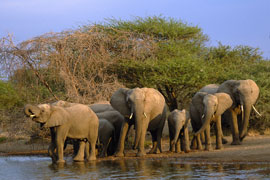
African Elephant
Socialisation: Elephants are generally
gregarious and form small family groups
consisting of an older matriarch and three or
four offspring, along with their young. It was
once thought that family groups were led by old
bull elephants, but these males are most often
solitary.
The female family groups are often visited by
mature males checking for females in estrus.
Several interrelated family groups may inhabit
an area and know each other well. When they meet
at watering holes and feeding places, they greet
each other affectionately.
Reproduction: Single young born any time
of the year. Gestation 22 months.
Life span: 60 to 70 years
Interesting Facts: The elephant is
distinguished by its high level of intelligence,
interesting behavior, methods of communication
and complex social structure. Elephants seem to
be fascinated with the tusks and bones of dead
elephants, fondling and examining them. The myth
that they carry them to secret "elephant burial
grounds," however, has no factual base.